


Engine hesitation at all temp on acceleration


Thread Starter
Junior Member
Posts like a V-Tak
Joined: Apr 2008
Posts: 26
Likes: 0
From: Connecticut

 Engine hesitation at all temp on acceleration
I have a 93 Bonnie SI 118000 miles. At all engine temperatures the car hesitates on take off from a complete stop - almost feels like a flat spot - if I play with the gas pedal I can move past the hesitation and then pickup is normal past 5 mph or so.
I don't know if this issue is related - possibly same throttle position - Ithe engine/tranny feels like it is lunging or rocking at about 45 mph - shakes the drivers seat - it seems to clear up once the car shift into overdrive.
Any thoughts on the above will be apprieciated...
Thanks.....
I don't know if this issue is related - possibly same throttle position - Ithe engine/tranny feels like it is lunging or rocking at about 45 mph - shakes the drivers seat - it seems to clear up once the car shift into overdrive.
Any thoughts on the above will be apprieciated...
Thanks.....

Senior Member
Posts like a Turbo
Joined: Feb 2007
Posts: 494
Likes: 0
From: Alabama
The shift issue at 45 sounds normal unless it'* violently shuddering. All of our cars have a little "rock" or shudder to them when the TCC engages under light throttle, which occurs at 45 mph (again at light throttle).
As for the hesitation, one potential culprit is a dirty throttle body.
.
.
.
As for the hesitation, one potential culprit is a dirty throttle body.
.
.
.

Senior Member
Posts like a Turbo
Joined: Jan 2008
Posts: 281
Likes: 0
From: Memphis, TN
Cleaning the MAF sensor may buy you some better response. Don't use carb cleaner. Parts stores sell a spray for MAFs. Remove it and you should see 2 tiny wires in a cylinder. Clean those.
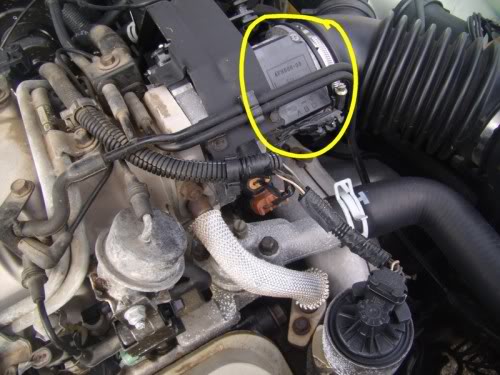
You may also have an ignition issue with one or more cylinders (plug wires, plugs, or coil(*)). This mainly appears when under load.
You may also have an ignition issue with one or more cylinders (plug wires, plugs, or coil(*)). This mainly appears when under load.
Thread Starter
Junior Member
Posts like a V-Tak
Joined: Apr 2008
Posts: 26
Likes: 0
From: Connecticut
Hesitation, shaking at 45 mpg
I have replaced the plugs and wires - so I'm fairly confident that is not the issue of the hesitation but I will check/clean the MAF sensor - Thanks
The engine/tranny does shake violently at 45 mpg or so - I usually try to ease up and down on the gas pedal to help it get past this point - sometimes its 3 or 4 minutes until the shaking stops. Is an engine vacuum hose leak a possible cause - I see a vacuum hose going to the tranny - it looks intact - or a faulty electronic computer sensor a possible cause - I also see an electric connectior goiing to the tranny - I have cleaned and reseated it?
Any thoughts?
The engine/tranny does shake violently at 45 mpg or so - I usually try to ease up and down on the gas pedal to help it get past this point - sometimes its 3 or 4 minutes until the shaking stops. Is an engine vacuum hose leak a possible cause - I see a vacuum hose going to the tranny - it looks intact - or a faulty electronic computer sensor a possible cause - I also see an electric connectior goiing to the tranny - I have cleaned and reseated it?
Any thoughts?
Senior Member
Posts like a Turbo
Joined: Jan 2008
Posts: 281
Likes: 0
From: Memphis, TN
Q1: Can you tell if the shuddering, if that is the right word, is right when the torque conv. clutch engages... or does it do it AFTER TCC is engaged?
If it does it AFTER, then the engine is usually more to blame. Otherwise, from FSM, it is more internal to the converter/trans. etc.
Q2: If idling in Park, have you tried "stabbing" the throttle VERY quickly to see if it has what I call a "crappy" spot?
If it does it AFTER, then the engine is usually more to blame. Otherwise, from FSM, it is more internal to the converter/trans. etc.
Q2: If idling in Park, have you tried "stabbing" the throttle VERY quickly to see if it has what I call a "crappy" spot?
Thread Starter
Junior Member
Posts like a V-Tak
Joined: Apr 2008
Posts: 26
Likes: 0
From: Connecticut
tranny shift issue
Q1 - as best as I can tell the studdering is right when the torque conv. clutch engages and the studdering can last for 2 to 3 minutes one day and the next day it engages smoothly. Is this caused by a sensor or converter going south?
Q2 - yes - when stabbing the throttle very quickly from idle there is a a "crappy" spot. What does this point to?
Q2 - yes - when stabbing the throttle very quickly from idle there is a a "crappy" spot. What does this point to?
Senior Member
Posts like a Turbo
Joined: Jan 2008
Posts: 281
Likes: 0
From: Memphis, TN
My 93 had these symptoms and I chased the problem for weeks. I also had new wires and plugs. The coils all passed the resistance checks.
Anyway, crapping out with acceleration and/or load is often ignition related.
Q: Have you notice and spitting at idle?
Here is a quick and easy check to see if you have one or more cylinders that are not up to par in the ignition department. It may find a coil or 2 going bad. This is a "live" test, rather than just the resistance check.
1. Start motor and let it calm down a little (should only take a few seconds to a min. or so)
2. Unplug the IAC valve (near the TPS on the throttle body and is a black cylinder shaped item)... not to exceed 2 min. at a time.
3. Pull the plug wires off at the coils one at a time. I like to use rubber handled pliers and rubber gloves. It will still give you a little tickle when the wire is put back on.
OR, an option would be to shut it off in between, put the wire back on and then restart to check the next one and so on. It needs to be running when you pull one though. Plus the "tickle" doesn't come when you remove the wire, it'* when you put it back on.
4. When you pull a wire off a GOOD coil output, it is normal for arcing back to the coil body. So, if it does NOT arc, suspect an issue with that coil output. It can be bad on one output of the two and the other to work okay.
If you suspect a coil, you can do a resistance measurement across the 2 output terminals. I believe it would be around 15k ohms on a good one; or infinity (open) on a zapped one.
Anyway, crapping out with acceleration and/or load is often ignition related.
Q: Have you notice and spitting at idle?
Here is a quick and easy check to see if you have one or more cylinders that are not up to par in the ignition department. It may find a coil or 2 going bad. This is a "live" test, rather than just the resistance check.
1. Start motor and let it calm down a little (should only take a few seconds to a min. or so)
2. Unplug the IAC valve (near the TPS on the throttle body and is a black cylinder shaped item)... not to exceed 2 min. at a time.
3. Pull the plug wires off at the coils one at a time. I like to use rubber handled pliers and rubber gloves. It will still give you a little tickle when the wire is put back on.
OR, an option would be to shut it off in between, put the wire back on and then restart to check the next one and so on. It needs to be running when you pull one though. Plus the "tickle" doesn't come when you remove the wire, it'* when you put it back on.
4. When you pull a wire off a GOOD coil output, it is normal for arcing back to the coil body. So, if it does NOT arc, suspect an issue with that coil output. It can be bad on one output of the two and the other to work okay.
If you suspect a coil, you can do a resistance measurement across the 2 output terminals. I believe it would be around 15k ohms on a good one; or infinity (open) on a zapped one.

Member
Posts like a V-Tak
Joined: Sep 2007
Posts: 84
Likes: 0
From: Lebanon, MO
If you'll note my previous recent post, I had the same problem with stuttering and bucking after TCC lock-up. It was one or more of the coil packs--all of which ohmed out good. I replaced all three rather than juggle them around, and it fixed the problem. They were $39 each at O'Reilly. (Just as an aside, I would never buy electronic stuff at Autozone. NAPA is my first choice, but we don't have one here any more.) It was also hesitating on initial acceleration, although not as bad as yours. Doesn't do that anymore either. That'* called a "tip-in stumble" and can be, as already noted, a lot of things. Quite often it'* the MAF sensor, and in second place, the Throttle Position Sensor (TPS). At least that'* my experience.
Thread Starter
Junior Member
Posts like a V-Tak
Joined: Apr 2008
Posts: 26
Likes: 0
From: Connecticut
Hesitation
I'm going to test the coils this weekend and probably replace all 3 if any are bad. I have an Advance Auto Parts store in town - each coil is 27$ and change.