


Mystery! Where Is the Starter Enable Relay?


Thread Starter
Member
Posts like a V-Tak
Joined: Jun 2023
Posts: 31
Likes: 31


Thread Starter
Member
Posts like a V-Tak
Joined: Jun 2023
Posts: 31
Likes: 31
 Followup
* On the chance I was unclear in my messaging about this problem, a few cellphone photos probably would help me determine exactly where I should expect to find the starter enable relay. That, of course, with the understanding various models sometimes have different part locations.
Thread Starter
Member
Posts like a V-Tak
Joined: Jun 2023
Posts: 31
Likes: 31
 MiniFuse 2E Discovery
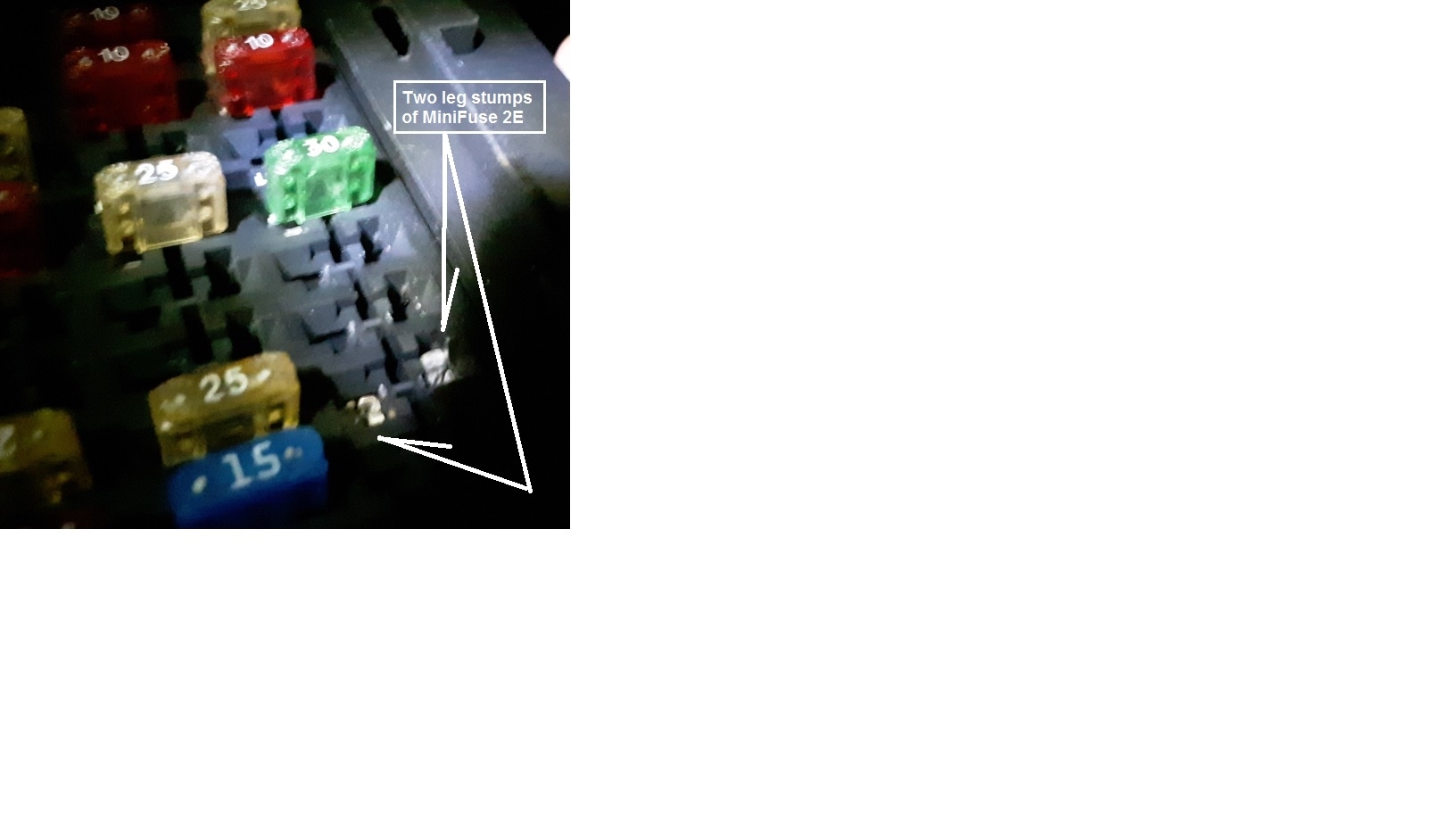
Rechecking MiniFuse 2E-- The socket appeared empty on first inspection. Looking more closely, I saw-- inside each leg of the socket-- was what appeared to be the silver stump of a MiniFuse.
Apparently, MiniFuse 2E had blown/melted, and its red plastic cap had fallen off, leaving only the two metal remnants of the fuse, deep in the socket. Tomorrow, I'll use a turkey basting needle to probe inside the socket to pry out the fuse leg stump. If I am successful with that operation, the next step is to insert another 10A fuse and see what happens.
The problem with that approach is gaining full access to the MiniFuse socket panel, which faces downward, toward the floor.
1. The MiniFuse panel is not an array of separate sockets, so I cannot remove only socket 2E.
2. Disconnection of the airbag and all MiniFuse wires to release the MiniFuse panel connections seems a very awkward solution.
The lower left dash shroud contains a mount for the MiniFuse panel, but fingertip exploration has not revealed how the MiniFuse panel attaches to the mount on the lower left dash shroud. The MiniFuse panel does not seem to slide or snap into place on the mount.
Attached below is a photo of the MiniFuse 2E socket, showing a fusible metal stump in each socket.
Image (Click to make bigger)



Thread Starter
Member
Posts like a V-Tak
Joined: Jun 2023
Posts: 31
Likes: 31
So far, the needle nose cannot grip the exposed metal stump with enough holding power to permit extraction. Which illustrates the problem-- I need to have better access to socket 2E. To make the operation simpler, I would like to detach all wires to the lower dash shroud that do not connect to the Minifuse panel, reorient the newly-freed shroud and work on the Minifuse panel from a better angle. However, working access is not the only problem..
At the moment, I must work with the lower dash shroud in my left hand, turning its corner down to expose the Minifuse panel, but cannot see very much of the area of interest. At first, I attempted to use a surgical clamp to pull out what appears to be a stump or remnant of the original Minifuse blade, but could not. After that, I tried the needlenose, but it failed for the same reason as the clamp-- not enough surface to grip fthe stump ifrmly. Failing that, I tried to push a straight pick through the back of the socket, hoping to engage the metal stump, but so far, there is not enough room for the pick to slide past the wire in the socket.
It seems the only way to prove Minifuse 2E is the key to restarting the Buick is to remove the two wires entering the socket from the back-- a large diameter white wire, and a small diameter dark-brown wire-- and attach these securely to a 10A red capped Minifuse. I probably could solder them onto the Minifuse short-term, and longer-term (failing to remove the two metal stumps).
Is there a speciallpuller for already inserted Minifuse panel wires?
At the moment, I must work with the lower dash shroud in my left hand, turning its corner down to expose the Minifuse panel, but cannot see very much of the area of interest. At first, I attempted to use a surgical clamp to pull out what appears to be a stump or remnant of the original Minifuse blade, but could not. After that, I tried the needlenose, but it failed for the same reason as the clamp-- not enough surface to grip fthe stump ifrmly. Failing that, I tried to push a straight pick through the back of the socket, hoping to engage the metal stump, but so far, there is not enough room for the pick to slide past the wire in the socket.
It seems the only way to prove Minifuse 2E is the key to restarting the Buick is to remove the two wires entering the socket from the back-- a large diameter white wire, and a small diameter dark-brown wire-- and attach these securely to a 10A red capped Minifuse. I probably could solder them onto the Minifuse short-term, and longer-term (failing to remove the two metal stumps).
Is there a speciallpuller for already inserted Minifuse panel wires?
Thread Starter
Member
Posts like a V-Tak
Joined: Jun 2023
Posts: 31
Likes: 31
Latest Informaton, July 20
For some reason, I believed I had responded to your question, but here is the same response, just in case I had not.
I have several needlenose pliers, but none could grip what I presume to be the metal stumps in the MiniFuse 2E socket. After several attempts, I found even a small pick would not move either stump. Also, there is no room in the socket back side to insert a pick of any kind.
Here is what I believe may be happening. Weeks previous to the no-crank situation, I had found MiniFuse 2E was reluctant to insert all the way into its socket, I removed it and tried reinsertion. The situation was no better, but the car started normally.
At that time, I had not looked inside the socket before I reinserted the fuse, but now I suspect the metallic stumps were already present in the socket, a remnant of someone'* previous work on the car. The stumps had prevented full insertion, which accounted for the strange feel during insertion.
According to my theory, when I discovered a red-capped 10A MiniFuse on the floormat, I presumed the fuse was a left-over from previous maintenance. Since I never had seen a MiniFuse fall out, I did not check the MiniFuse 2E location in the MiniFuse panel. If I had, I would have noticed the fuse was missing. More than likely, during constant use, the fuse simply worked its way loose during its cooling cycle, after I had parked the car
This suggests I can insert another fuse, and successfully start the engine, which seems preferable to butchering the MiniFuse panel to remove the mysterious metal stumps I'll let you know what happens.
I have several needlenose pliers, but none could grip what I presume to be the metal stumps in the MiniFuse 2E socket. After several attempts, I found even a small pick would not move either stump. Also, there is no room in the socket back side to insert a pick of any kind.
Here is what I believe may be happening. Weeks previous to the no-crank situation, I had found MiniFuse 2E was reluctant to insert all the way into its socket, I removed it and tried reinsertion. The situation was no better, but the car started normally.
At that time, I had not looked inside the socket before I reinserted the fuse, but now I suspect the metallic stumps were already present in the socket, a remnant of someone'* previous work on the car. The stumps had prevented full insertion, which accounted for the strange feel during insertion.
According to my theory, when I discovered a red-capped 10A MiniFuse on the floormat, I presumed the fuse was a left-over from previous maintenance. Since I never had seen a MiniFuse fall out, I did not check the MiniFuse 2E location in the MiniFuse panel. If I had, I would have noticed the fuse was missing. More than likely, during constant use, the fuse simply worked its way loose during its cooling cycle, after I had parked the car
This suggests I can insert another fuse, and successfully start the engine, which seems preferable to butchering the MiniFuse panel to remove the mysterious metal stumps I'll let you know what happens.
Thread Starter
Member
Posts like a V-Tak
Joined: Jun 2023
Posts: 31
Likes: 31
This afternoon, I tried insertion of the 10A MiniFuse into socket 2E, but met mechanical resistance.
Now, I suspect the two bright metallic points are the original contact points for the socket. .
My next step is to make sure the battery is discomected, and use a small, flat-bladed screwdriver to open the contact points to allow me to insert the Minifuse.
Then, to test-start the engine.
Since my experience with Minifuses is only removal and insertion Sinceodd appearance of the socket is due to the
Thread Starter
Member
Posts like a V-Tak
Joined: Jun 2023
Posts: 31
Likes: 31
CarFixer007, CathedralCub
You will be pleased to know the problem has been resolved.
1. Apparently, the 10A red-capped MiniFuse was not properly in place in the original non-crank event, for some undetermined reason. Maybe the fuse was improperly inserted, but still, that is not likely-- I know how a properly inserted MiniFuse should feel as I push it into place. No explanation, yet.
2. I tested with an identical fuse from the airbag location 2C. Insertion of the fuse into the MiniFuse panel was easy-- no mechanical resistance, which means the original socket contacts are still OK.
Many thanks to all who helped!
You will be pleased to know the problem has been resolved.
1. Apparently, the 10A red-capped MiniFuse was not properly in place in the original non-crank event, for some undetermined reason. Maybe the fuse was improperly inserted, but still, that is not likely-- I know how a properly inserted MiniFuse should feel as I push it into place. No explanation, yet.
2. I tested with an identical fuse from the airbag location 2C. Insertion of the fuse into the MiniFuse panel was easy-- no mechanical resistance, which means the original socket contacts are still OK.
Many thanks to all who helped!



Thread Starter
Member
Posts like a V-Tak
Joined: Jun 2023
Posts: 31
Likes: 31
CarFixer007--
More evidence appeared this afternoon on the cause of the non-crank problem. This afternoon, when I restarted the engine after buying new MiniFuses at a local store, I remembered I had borrowed the 10A fuse from the airbag slot, and an airbag might turn out to be important, later. So, I turned off the engine, and inserted a 10A fuse into the MiniFuse airbag slot, but carefully and slowly. As I did so, the fuse seemed so loose, it might eventually fall out.
This could have happened with slot 2E, as well. As proof, when I tried to restart the engine, it failed to crank, just as with the original non-crank event. I removed and carefully examined the 2E fuse for any faults, but found none, except for the fact this Mini"Fuse is made of a very thin metal conductor. I reversed the orientation of the fuse, and made sure it was fully inserted and secure. The reversal of fuse position permitted the engine to restart.
Apparently, the MiniFuse panel sockets on this Buick 98 no longer "grip" the fuses are they once did, and produce weird and difficult diagnostics unless the malfunction is on the list of possible contributing conditions.
More evidence appeared this afternoon on the cause of the non-crank problem. This afternoon, when I restarted the engine after buying new MiniFuses at a local store, I remembered I had borrowed the 10A fuse from the airbag slot, and an airbag might turn out to be important, later. So, I turned off the engine, and inserted a 10A fuse into the MiniFuse airbag slot, but carefully and slowly. As I did so, the fuse seemed so loose, it might eventually fall out.
This could have happened with slot 2E, as well. As proof, when I tried to restart the engine, it failed to crank, just as with the original non-crank event. I removed and carefully examined the 2E fuse for any faults, but found none, except for the fact this Mini"Fuse is made of a very thin metal conductor. I reversed the orientation of the fuse, and made sure it was fully inserted and secure. The reversal of fuse position permitted the engine to restart.
Apparently, the MiniFuse panel sockets on this Buick 98 no longer "grip" the fuses are they once did, and produce weird and difficult diagnostics unless the malfunction is on the list of possible contributing conditions.